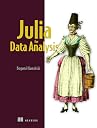
Julia for Data Analysis
Product ID: 452746817
Desertcart purchases this item on your behalf and handles shipping, customs, and support to French Polynesia.
Julia for Data Analysis [Kaminski, Bogumil] on desertcart.com. *FREE* shipping on qualifying offers. Julia for Data Analysis Review: Good book - Worthy, useful. Review: For individuals who are already familiar with data analysis, but want to learn Julia - Julia is a compelling option for scientists familiar with Python and R, as the language aims to make code readable and equally efficient as low-level libraries available in Python and R. The book written by Bogumił is a valuable resource for learning about Julia, as he is an expert in the language and has contributed to many of its open-source projects. The book is divided into two chapters, with the first chapter covering the fundamentals of the Julia language and the second chapter providing practical examples of using APIs, working with data in various formats, performing statistical analysis, visualizing data, and building machine learning models.
| Best Sellers Rank | #1,737,803 in Books ( See Top 100 in Books ) #511 in Data Modeling & Design (Books) #536 in Data Mining (Books) #721 in Data Processing |
| Customer Reviews | 3.9 out of 5 stars 21 Reviews |
A**N
Good book
Worthy, useful.
K**A
For individuals who are already familiar with data analysis, but want to learn Julia
Julia is a compelling option for scientists familiar with Python and R, as the language aims to make code readable and equally efficient as low-level libraries available in Python and R. The book written by Bogumił is a valuable resource for learning about Julia, as he is an expert in the language and has contributed to many of its open-source projects. The book is divided into two chapters, with the first chapter covering the fundamentals of the Julia language and the second chapter providing practical examples of using APIs, working with data in various formats, performing statistical analysis, visualizing data, and building machine learning models.
U**M
Not so easy to follow for beginner
Good - Authored by main developer of DataFrames.jl - Full of details Bad - Too much details and out-of-focus branches. - Not so easy to follow for beginner. (especially Part 2) Recommend to read other beginner book(or tutorials) before reading Part 2 of this book.
J**S
More geared towards developers than data analysts
This book requires the reader to already be skilled at data analysis in R or Python, and it does not really teach analysis workflows so much as describe language features of Julia or packages relevant to particular tasks. The book seems more geared towards package developers than for people doing interactive data analysis. For a book about data analysis, there was surprisingly little content on data visualization. For most readers, I would instead recommend checking out the Tidier.jl documentation and other resources if their primary interest is data analysis rather than package development.
O**O
The de-facto reference for the DataFrames.jl
This title by mr. Kaminsky is I believe the de-facto reference for the DataFrames.jl package. The book offers a solid introduction to data analysis using the Julia language. The first part of the book (chapters 1-7) provide the reader with an overview of the "essential" Julia language skills, addressing syntax, data types, and from here on, it builds its way into dealing with data-intensive manipulation, mainly through collections, strings and time-series data. The second part of the book delves into the data analysis realm of the title, and shows how Julia can help the reader with the manipulation of DataFrames. The author starts with the basics of (t)his package, then in numerous examples shows how to create data frame objects, retrieeve their data, and to do important operations with the data frame objects, i.e., convert and group, mutate and transform, etc. Some of the highlights in the book: * The author not only makes extensive use of DataFrames, but also of other packages for visualization, benchmarking, and even web-service creation to serve the data. * The companion sample code repository is very thorough, and not only contains pure julia files, but there are also notebooks in Jupyter and Pluto format * There a three generous appendices in the text, so the reader can A) learn to set up his/her Julia environment for the 1st time, B) find the answers to the proposed exercises in the text, and C) have an overview of recommended Julia packages for data analysis. Some of the parts I found difficult (, or perhaps aren't my cup of tea): - Quite some of the examples offered have to do with the financial world. This perhaps comes from the formation/background of the author. - The physical text might be bulky, but then again, dealing with data, you might expect to see many tables All in all, this title might blend well with McNicholas' "Data Science with Julia", and/or Nazarathy's "Statistics with Julia" for the more scientific readers.
T**N
Fabulous book for learning scientific computing basics with tabular data
I am a medical epidemiologist and I taught R programming for 15 years. Eventually I switched to the Julia Language. This book covers basic and intermediate Julia with a focus on mastering the DataFrames.jl package to managing data frames. The author is the primary developer of this package. The book is outstanding and I cannot recommended more highly.
C**G
Excellent introduction to both Julia and Data Analysis
I am a beginner programmer who has previously dabbled in both R and Python. Julia has been on my radar for a few years (since the 1,0 release), but I have previously used Python and Pandas for my data wrangling needs. Kamińskis book begins outlining why Julia is a good fit for data analysis tasks with illustrative examples, and then reviews both strengths and weaknesses of the language. Part one of the book introduces Julia in general and the tools needed to work in the language in a structured manner. Part two builds upon part one and introduces data analysis in Julia. Kamiński writes in a friendly and very readable manner, both explaining different ways of accomplish tasks and also highlighting common errors or quirks. Boxes often provide additional detail, clarifies important points or links to sources providing additional information, which I appreciated. Many chapters are built around small projects (such as extracting exchange rate data or analyzing chess puzzles) as a way to introduce concepts and tools, which gives good structure when learning. All in all this is an excellent introduction to both Julia and Data Analysis. Very little programming experience is needed in order to be able to use the material, and I feel it provides a very solid foundation for future projects in using Julia. In short Kamiński has written, what I consider to be, a pedagogical masterpiece!
M**.
Great book for jumpstarting your mastery of Julia!
I give this book a big thumbs up! It's extremely well structured and written, and covers both Julia language fundamentals and general analysis concepts, with a deeper look into the package DataFrames.jl. The book goes step-by-step through setting up Julia and working with different data types and collections. The author provides helpful comparisons and contrasts with Python and R, and detailed appendices. After covering language fundamentals, the second part of the book dives into the author's specialty: everything dataframes. The concepts and examples build progressively, and the excellent supporting exercises mirror real-life use cases. While aimed at data professionals already familiar with Python or R, the book isn't just an introduction to the Julia language. Where it really shines is as an excellent refresher on data analysis concepts and best practices (and not just beginner level - there are plenty of more advanced tips as well). This was one of the best books of its type that I've read - highly, highly recommend!
Trustpilot
1 month ago
1 month ago